Getting started
Your first session, in the order it actually happens — the colony, the energy wall, the first research and the first ship.
You begin with one colony on one planet, a small pile of resources and nothing built. This page walks the first session in the order it happens. It takes about ten minutes.
The colony
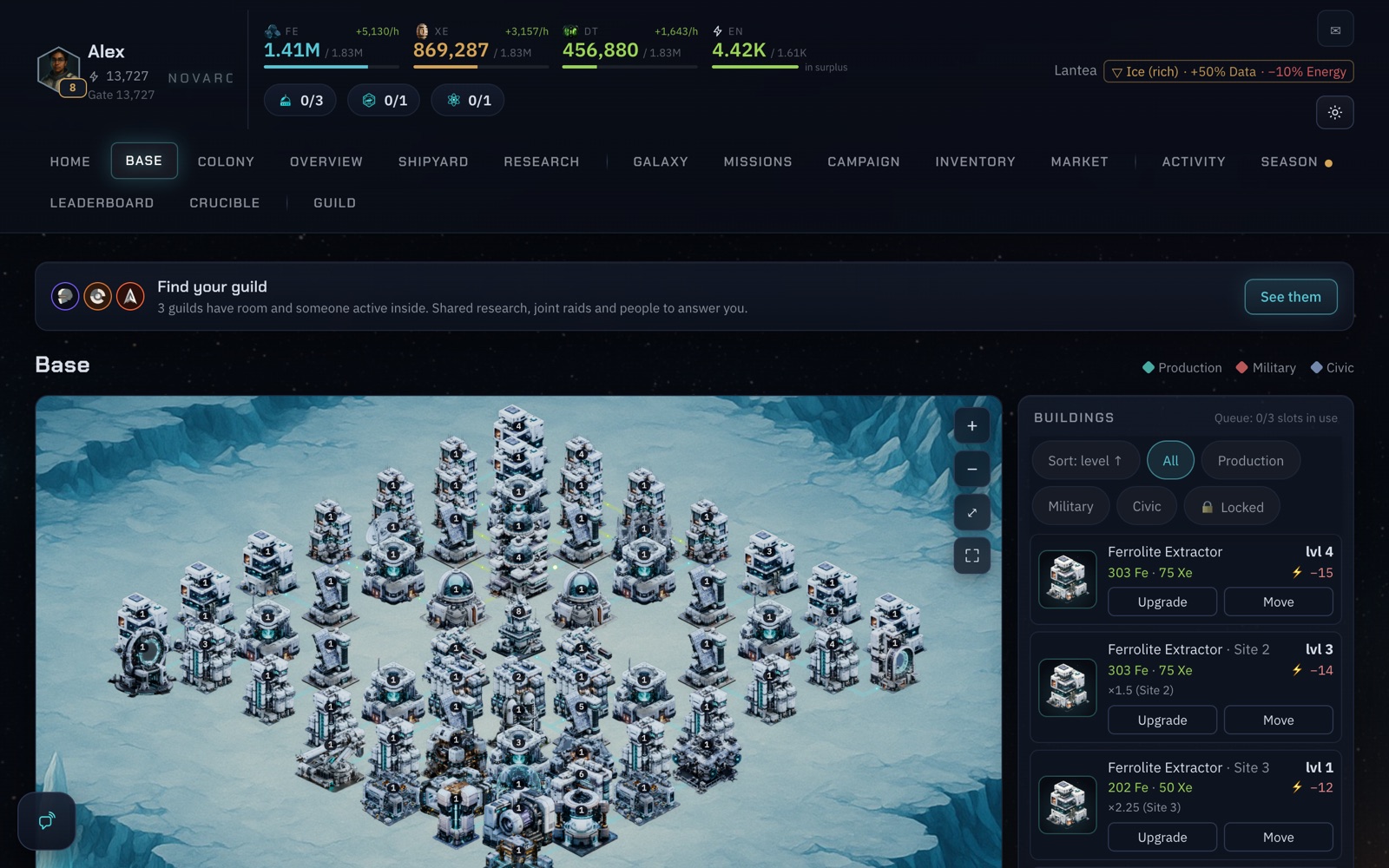
Your own colony starts nearly bare — this is what the same screen looks like once it is built up, so you can see where the pieces end up.
Everything starts here. The buildings you raise sit on the surface, and the strip along the top is your empire's state: what you hold, what you are producing, and what is coming toward you.
Build the Fusion Reactor first. This is the one piece of order that matters, and it is not obvious: a colony with no power runs at −100%, so an extractor built before a reactor produces nothing at all and gives you no hint why. Power is not stored — your colony makes it and spends it in the same instant, and the moment your draw passes your supply every producer slows down together, not just the one you added.
With the lights on, the rest follows: a Ferrolite Extractor, then a Xenogas Refinery, then a Warehouse before your first haul starts overflowing. Orbital Panels are the cheaper second source of power if you would rather not pay for another reactor yet.
Keep a little headroom. An upgrade that tips you into deficit costs you across the whole colony.
See Resources and energy for how the shortfall is shared out.
The Command Center
The Command Center is the building nobody tells you about, and it quietly gates most of the game: the Compute Node and the Laboratory want it at level 2, the Shipyard at level 3, and a second colony needs it much higher still. If something you expect to build is simply not in the menu, this is almost always the reason.
Research
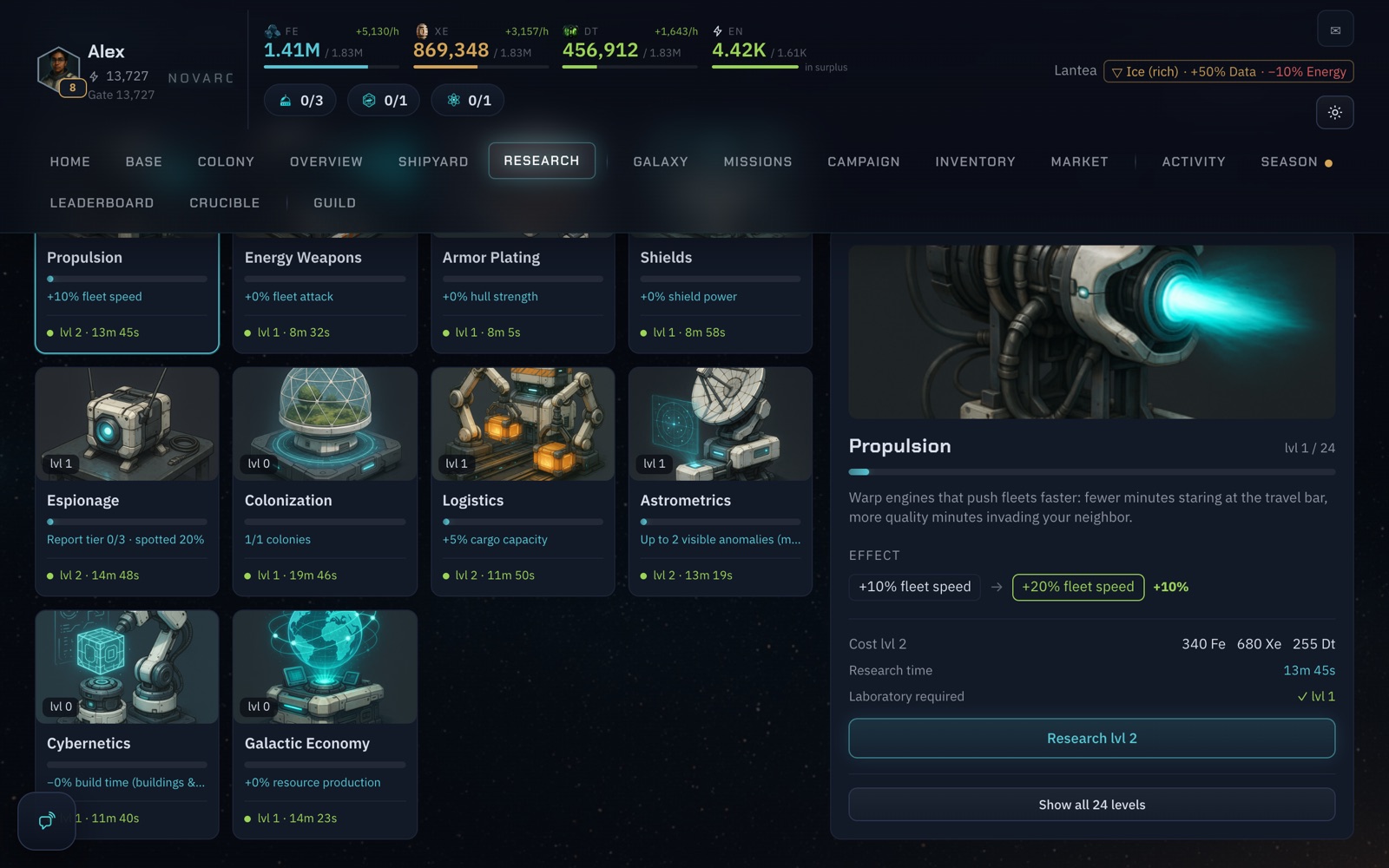
Research needs a Laboratory, and the Laboratory is the single best early investment you can make that does not feel like one. It runs two tracks at once:
- the ten disciplines, which climb continuously. Some are about ships — speed, guns, armour, shields — and the rest are not: colonising, spying, trade, cargo capacity, build times, and what you can see of the sky;
- the tech tree, which unlocks specific hulls, buildings and rules, gated by your Laboratory level and by prerequisites of its own.
Start with Logistics or Astrometrics. Neither is exciting; Logistics widens every cargo hold you own and Astrometrics is what makes anomalies visible at all, and both pay from the first level onward.
Your first fleet
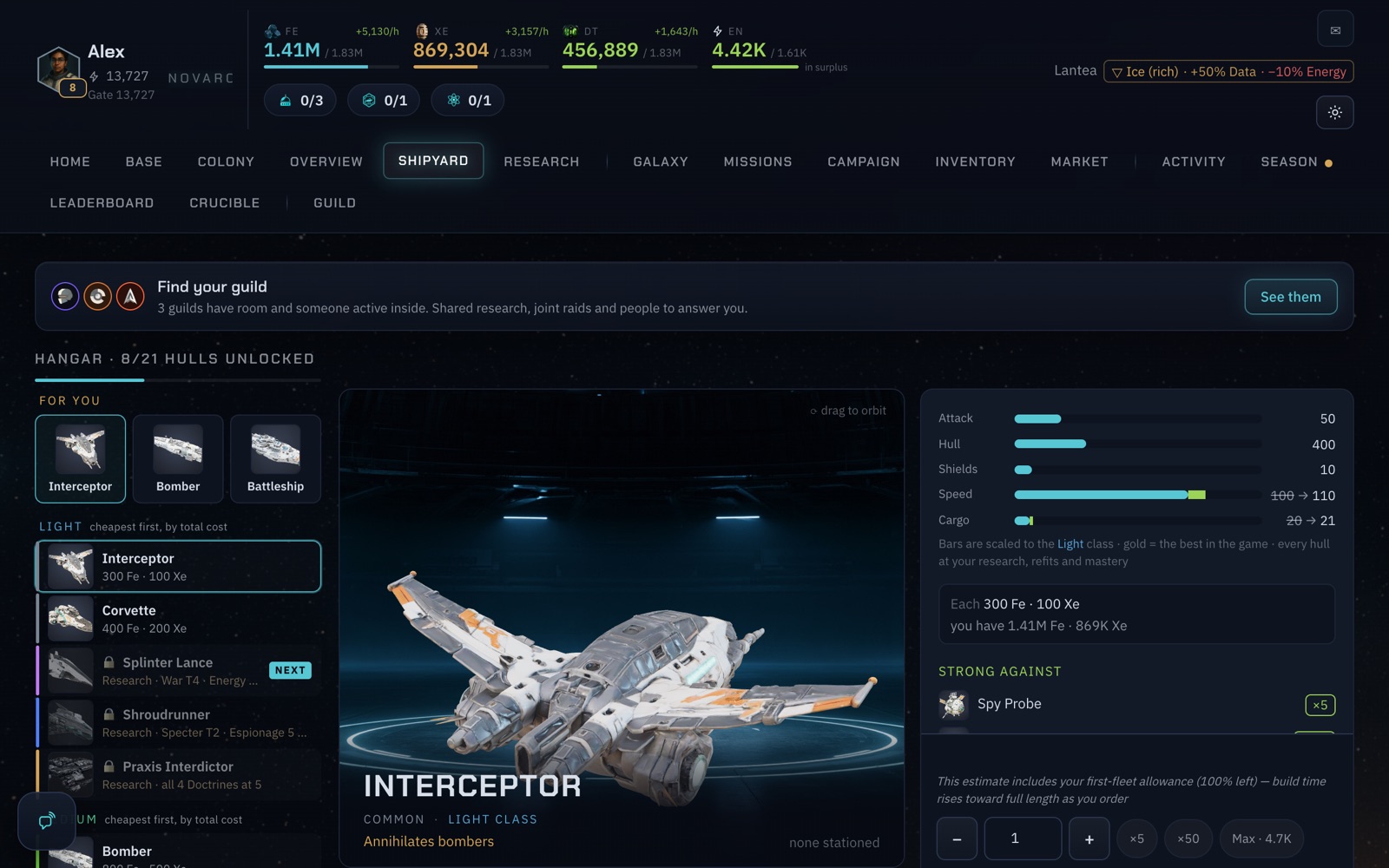
Ships come out of a Shipyard. The first thing to understand about combat here is that it is not a contest of totals: the catalogue is a counter matrix, and a smaller fleet bringing the right classes beats a larger one bringing the wrong ones. Before you commit resources, look at what a hull is strong against on the Ships page.
Your first hulls are better spent on cargo and scouting than on a raid. You cannot lose what you have not sent.
The galaxy
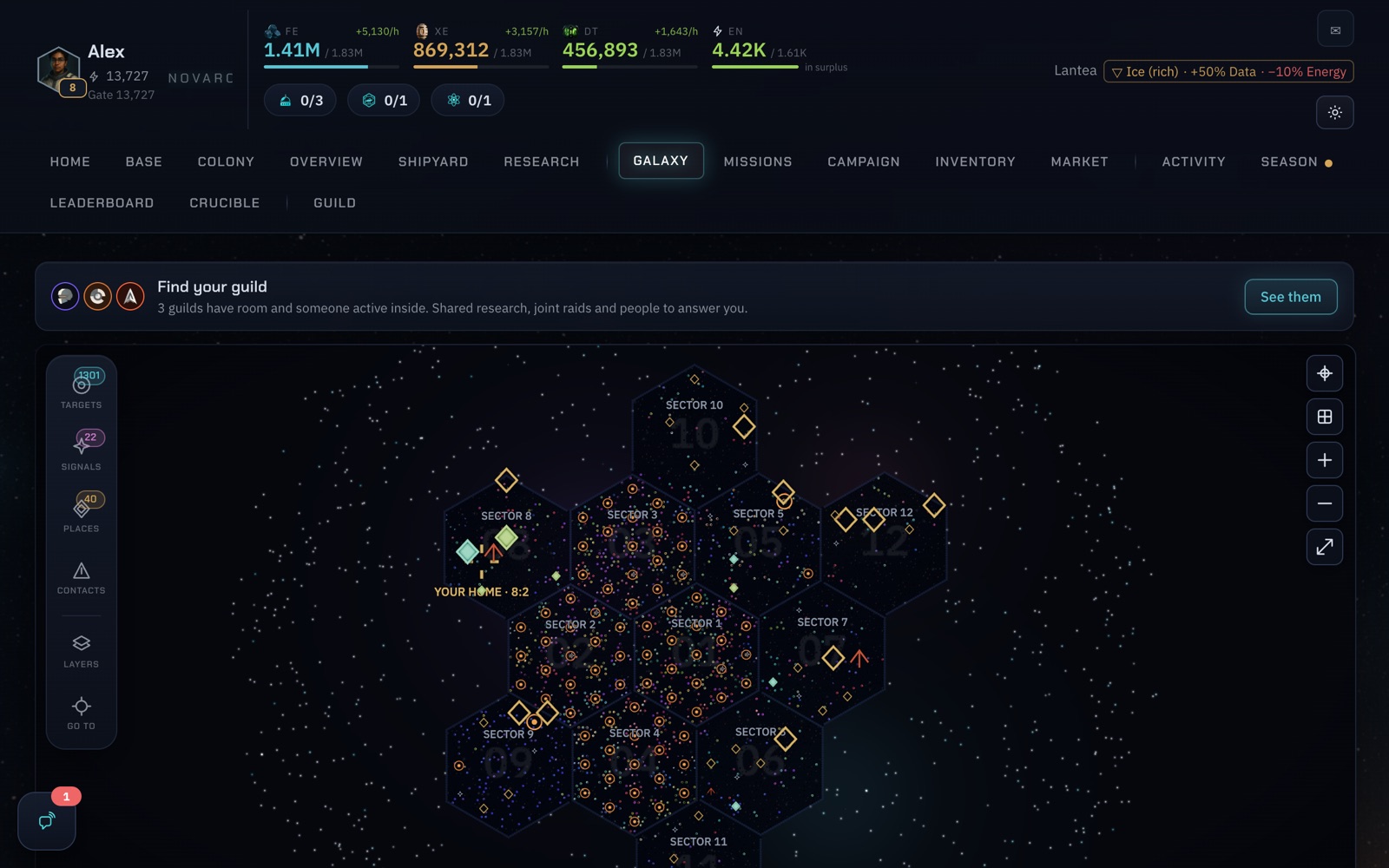
This commander's home sits well outside the protected sectors — which is where you end up once you go looking for the better worlds, not where you start.
The map is sectors, systems and planets. The inner sectors are protected space — where new empires are born, and where the server holds raiding to tighter rules. The rich worlds, the wreckage and the three factions are further out. That is the trade the whole map is built around: safety near the middle, reward at the edge.
A second colony is the biggest single step up in the game, and it has two gates, not one: the Colonization discipline and your Command Center, which has to reach level 6 before a second colony slot exists at all. Buying Colonization on its own will not open one — check the Command Center before you spend.
What to do next
- Read Protection and set your night window. It takes ten seconds and it is the rule that lets you stop thinking about the game when you close it.
- Join a guild. Almost everything at the top of the leaderboard is done by groups.
- Say something in chat. Your neighbours will answer — including the ones with a mark beside their name.